
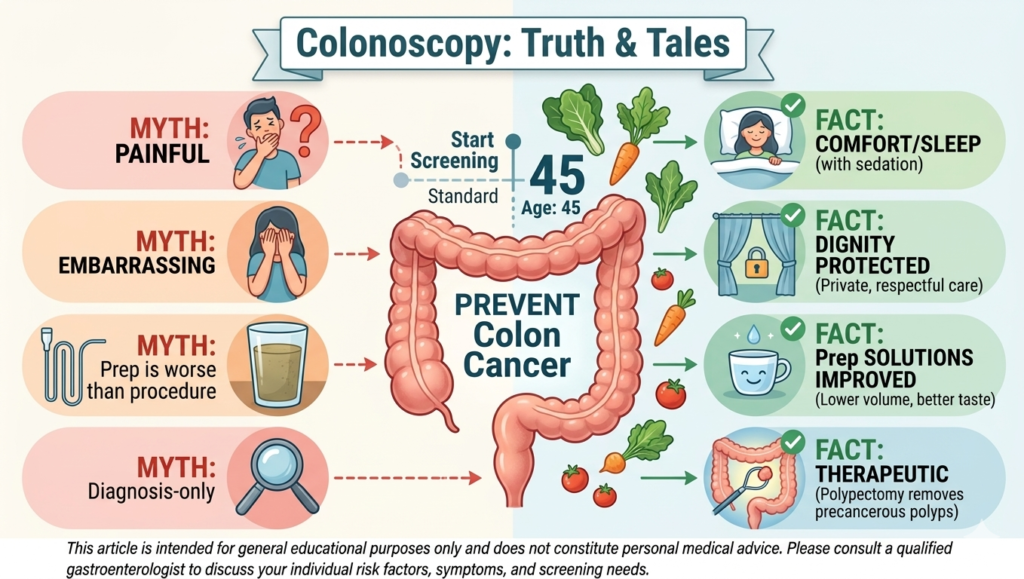
Colonoscopy: Truth & Tales
Separating Medical Facts from Common Myths
Colonoscopy is one of the most powerful tools in modern preventive medicine—yet many people delay it for years due to fear, embarrassment, or misinformation.
As a gastroenterologist, I frequently answer questions like:
- Is colonoscopy painful?
- Is colonoscopy embarrassing?
- Do I really need a colonoscopy if I have no symptoms?
- Is colonoscopy preparation worse than the procedure?
The truth? A screening colonoscopy is usually far simpler, safer, and more comfortable than most people imagine. Let’s separate medical facts from common colonoscopy myths.
Who Should Consider a Colonoscopy?
Colonoscopy is recommended for anyone aged 45 or older, even without symptoms—but certain people should consider it sooner, for example in case of:
- Family history of colorectal cancer or colon polyps
- Personal diagnosis of inflammatory bowel disease (Crohn's disease or ulcerative colitis)
- Unexplained iron-deficiency anemia
- Rectal bleeding
- Persistent changes in bowel habits
Colon cancer often develops silently in its early stages, making proactive screening essential regardless of how well you feel. Every person's risk profile is different. If you are unsure whether you need a colonoscopy now or can wait, a consultation with a gastroenterologist can provide a personalized answer.
Colonoscopy Myth #1: “A Colonoscopy Is Extremely Painful”
Truth: Most patients feel nothing at all.
Modern colonoscopy procedures are commonly performed under deep sedation. Patients sleep comfortably during the exam and typically wake up surprised that it is already finished. The procedure itself usually lasts 20–40 minutes, and when sedation is properly administered, discomfort is rare.
Colonoscopy Myth #2: “It’s Embarrassing”
Truth: Your dignity and privacy are fully protected.
This concern is very common—and completely understandable. During a colonoscopy:
- Patients are carefully draped
- Exposure is kept to an absolute minimum
- Privacy is maintained at every stage
- The medical team is focused entirely on safety and clinical care
Colonoscopy Myth #3: “I Don’t Need One If I Feel Fine”
Truth: Colon cancer often develops silently.
Colorectal cancer typically begins as small growths called colon polyps. These precancerous polyps cause no symptoms. By the time symptoms appear (such as rectal bleeding, weight loss, or abdominal discomfort), the disease may already be advanced. Colonoscopy is a preventive tool—you act before the disease has a chance to develop.
Colonoscopy Myth #4: “The Preparation Is Worse Than the Procedure”
Truth: Colonoscopy prep has improved significantly.
Modern prep solutions are now lower in volume, better tolerated, and often split into two smaller doses. A clean colon allows for better polyp detection and a safer, more accurate examination. Good preparation directly improves the quality of your screening.
Colonoscopy Myth #5: “If They Find Something, It Means Surgery”
Truth: Most colon polyps are removed during the same procedure.
If a precancerous polyp is detected, it can almost always be removed immediately during the colonoscopy—without surgery and without a second procedure. This is what makes the test so powerful: it doesn't just detect cancer; it prevents it.
Colonoscopy Myth #6: "Once You Have One, You'll Need It Every Year"
Truth: For most people, a normal result means no repeat for 10 years.
If your results are normal and you are at average risk, guidelines generally recommend repeating the screening only every 10 years. For most patients, one colonoscopy buys nearly a decade of peace of mind.
Why Colonoscopy Is the Gold Standard
Colorectal cancer is one of the most common cancers in the UAE and across the GCC region. Colonoscopy is unique because it can:
- Detect colorectal cancer at an early stage
- Identify precancerous polyps
- Remove polyps before they become cancer
The Bottom Line: Is Colonoscopy Worth It?
In my daily practice, I often see patients relieved by how simple the procedure actually is. Colonoscopy is not something to fear—it is something to value. In less than an hour, you gain clarity, reassurance, and often years of protection.
If you have questions about colonoscopy or would like to discuss your personal screening plan, I would be happy to help. You are welcome to book a consultation at Healthbay Day Surgery Centre—early action is always the right decision.
This article is intended for general educational purposes only and does not constitute personal medical advice. Please consult a qualified gastroenterologist to discuss your individual risk factors, symptoms, and screening needs.